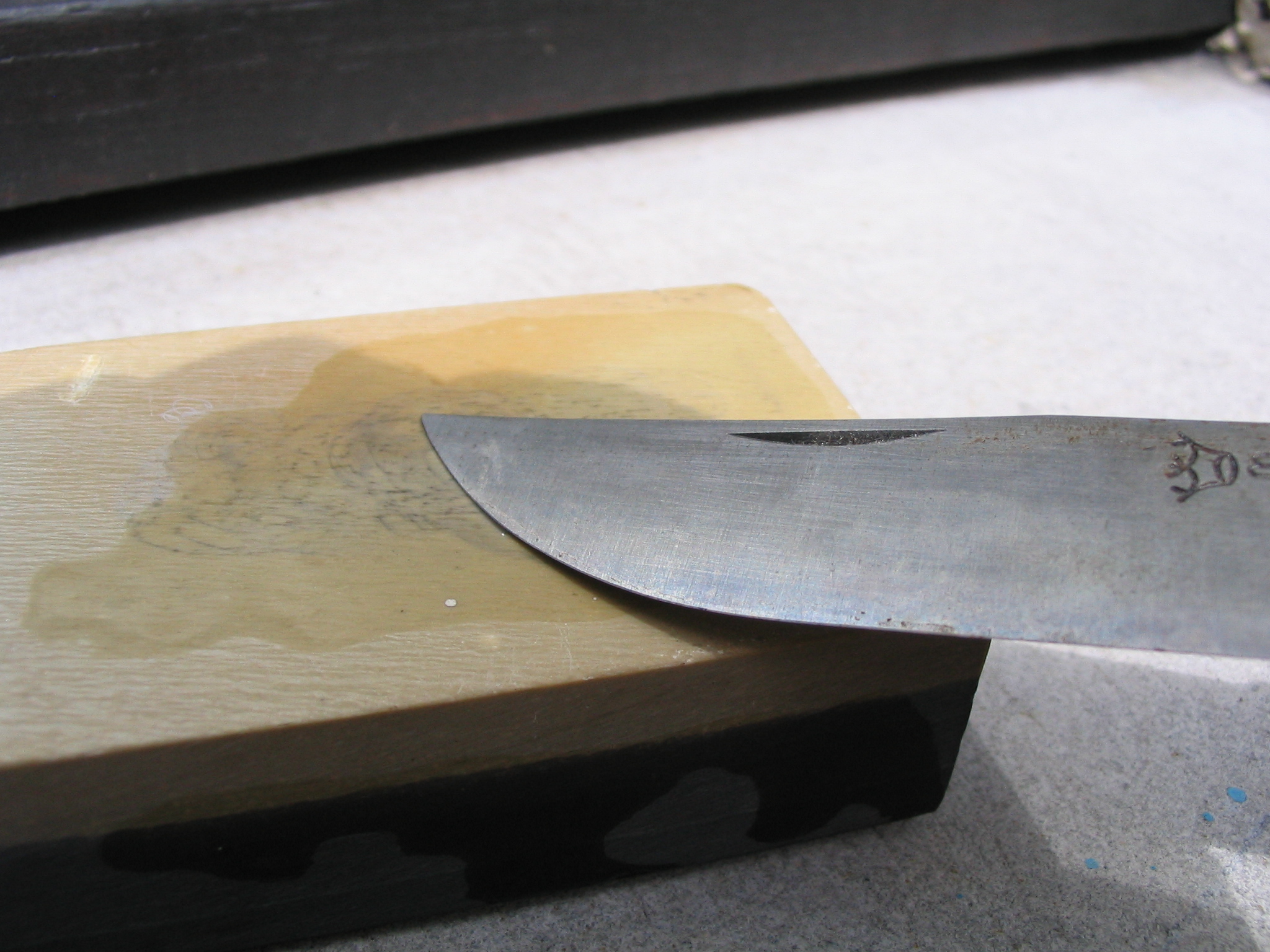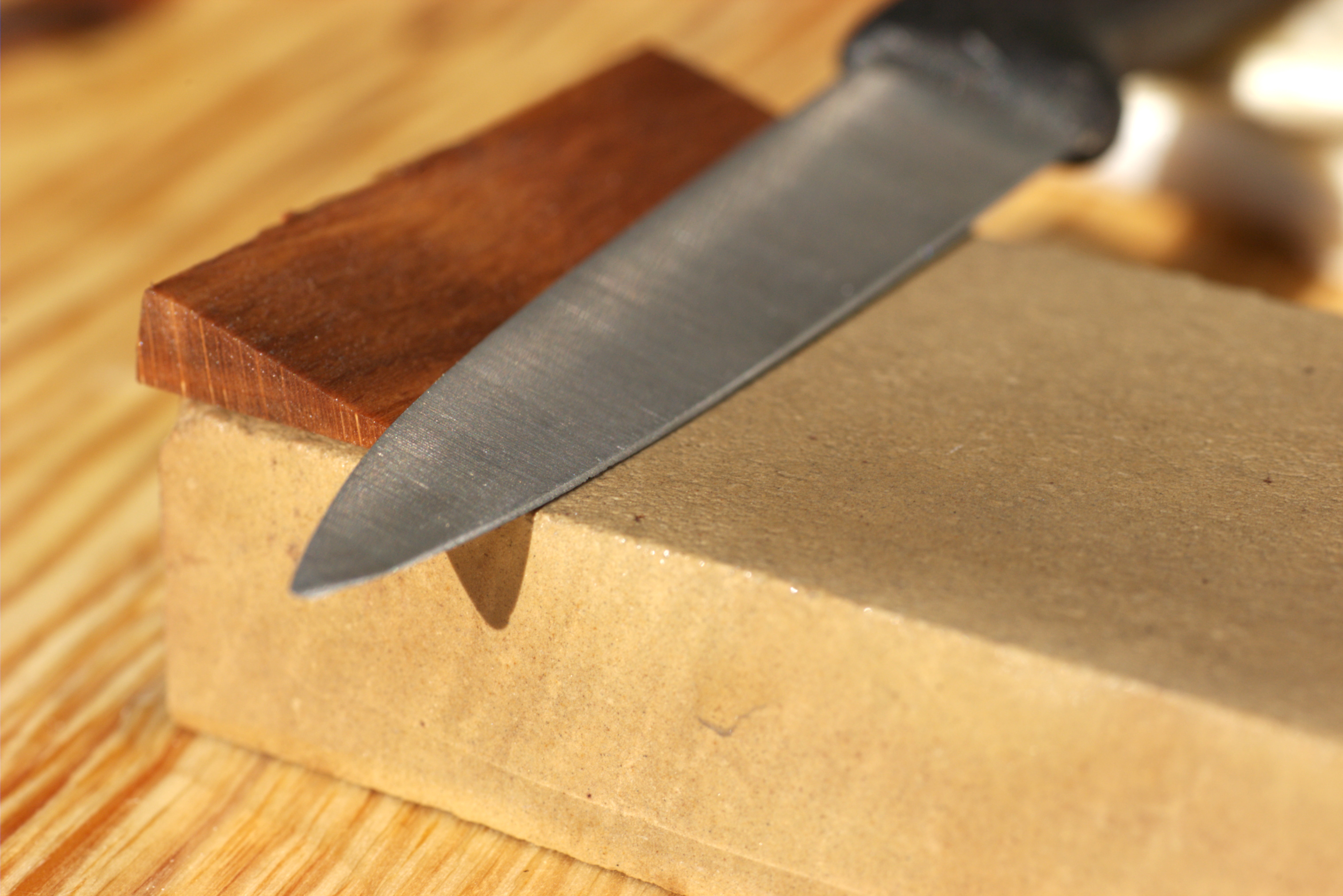
What the Angle Represents
The sharpening angle is measured from the face of the blade to the surface of the stone. When a manufacturer specifies a blade at “20 degrees,” they usually mean 20 degrees per side, giving a total included angle of 40 degrees. Some Japanese knife manufacturers specify the total angle rather than the per-side measurement, so it is worth checking which convention is being used when consulting any reference data.
The included angle has a direct effect on performance. A 30-degree included angle (15° per side) holds an edge that slices cleanly through soft tissue with minimal resistance. A 60-degree included angle (30° per side) is more appropriate for tools that encounter grit, bone, or fibrous wood.
Reference Table by Blade Type
| Blade Type | Angle Per Side | Notes |
|---|---|---|
| Japanese chef’s knife (gyuto) | 10–15° | Thin bevel, fine steel; fragile on hard foods |
| European chef’s knife | 15–20° | Standard domestic kitchen knife |
| Paring knife | 15–20° | Same range as chef’s knife; control more important than edge fineness |
| Bread knife (serrated) | Not applicable | Individual serrations sharpened with a tapered rod; bevel angle pre-set |
| Hunting / bushcraft knife | 20–25° | Balance between sharpness and edge retention |
| Axe | 25–30° | Impact tool; robust bevel required |
| Garden hoe blade | 25–30° | Contact with soil and stones; durability over sharpness |
| Pruning shears (secateurs) | 25–35° | Asymmetric bevel on many designs; check the original bevel before sharpening |
| Lawn mower blade | 30–45° | High-impact tool; file-sharpened at the factory bevel |
How Angle Affects Cutting Performance
Low Angles (10–15° per side)
A 10–15 degree angle produces the sharpest possible edge from a given steel. Japanese kitchen knives are often ground at this range because they are made from harder steel (typically 60 HRC and above on the Rockwell scale) that can hold such a thin edge without rolling. The trade-off is brittleness: these edges chip if used to cut through bones, frozen food, or hard cheese rinds.
Mid Range (15–20° per side)
The majority of German and French kitchen knives leave the factory at 15–20 degrees. This range offers a practical compromise: sharp enough for most cutting tasks, durable enough to tolerate occasional contact with harder surfaces. It is also the range most pull-through sharpeners are designed around, which is why results from those devices are often adequate for European-style knives.
Higher Angles (20–30° per side and above)
Garden tools and tools that encounter abrasive materials are typically sharpened at higher angles. A garden spade sharpened at 20–25 degrees per side will hold its edge longer than one sharpened more finely, even though the actual cutting action through soil is less clean. For tools used in Polish sandy soil, where quartz particles act as a continuous mild abrasive, a more robust bevel extends the interval between sharpenings.
Maintaining a Consistent Angle
Angle consistency is the main source of difficulty for people learning whetstone sharpening. Several approaches help maintain a steady angle throughout a sharpening session.
Mechanical Angle Guides
Angle guide clamps attach to the spine of the knife and rest on the stone surface, setting a fixed angle mechanically. Guides from Lansky, Spyderco, and Ruike are available in Poland through online retailers and provide a reliable way to learn muscle memory before attempting freehand sharpening.
Reference Points
Without a guide, a useful reference for 15 degrees is to place two stacked credit cards under the spine of the knife when the blade is flat on the stone. For 20 degrees, three cards approximate the height. This is an approximation and varies with knife blade width, but provides a repeatable starting position.
Marker Technique
Draw a line along the bevel face with a permanent marker before sharpening. After two or three strokes, examine which part of the marker has been removed. If the marker is removed from the edge only, the angle is too low. If removed from the spine side only, the angle is too high. When the full bevel face shows even removal, the angle matches the existing bevel.
Single-Bevel vs. Double-Bevel Knives
Most Western kitchen knives are double-bevel: the same angle is ground on both sides. Traditional Japanese kitchen knives such as the yanagiba or deba are single-bevel: the front face is ground at a low angle, the back face is nearly flat. Single-bevel knives require a different technique and must only be sharpened on the bevel side; touching the flat back on a coarse stone can damage the geometry permanently.